
More Hydropower, More Blackouts? The Paradox Behind Burundi’s Electricity Crisis
D-
Burundi has substantially expanded its hydroelectric electricity generation capacity. Yet, during this past exceptionally dry season, households and businesses in Bujumbura have been experiencing repeated and prolonged power cuts. How can a country have enough generation capacity on paper, but insufficient electricity when it is needed most? The answer reveals a critical challenge for Burundi’s energy future: increasing capacity is not the same as building resilience.
An electricity crisis in a country with growing generation capacity
For many residents of Bujumbura, electricity shortages sometimes lasting up to days have become an exhausting part of everyday life. Power cuts disrupt businesses, interrupt production, affect working conditions and complicate the most basic household activities.
But the explanation for the current crisis is particularly revealing.
According to statements by REGIDESO's Director General, Jean Albert Manigomba, reported by Jimbere and Le Renouveau in October 2026, Burundi's estimated electricity demand is approximately 116 megawatts (MW). Available generation capacity can reach approximately 180 MW under favorable conditions. Yet, during this past dry season, available power has fallen to less than 70 MW.
These figures suggest a generation shortfall of more than 46 MW, equivalent to more than 39% of estimated demand. (This is an indicative comparison of the reported figures, not a measurement of unmet electricity consumption.)
The distinction is essential: Burundi may have sufficient installed generating equipment to meet demand when hydrological conditions are favorable, but much of that equipment depends on a resource that is not consistently available.
Water.
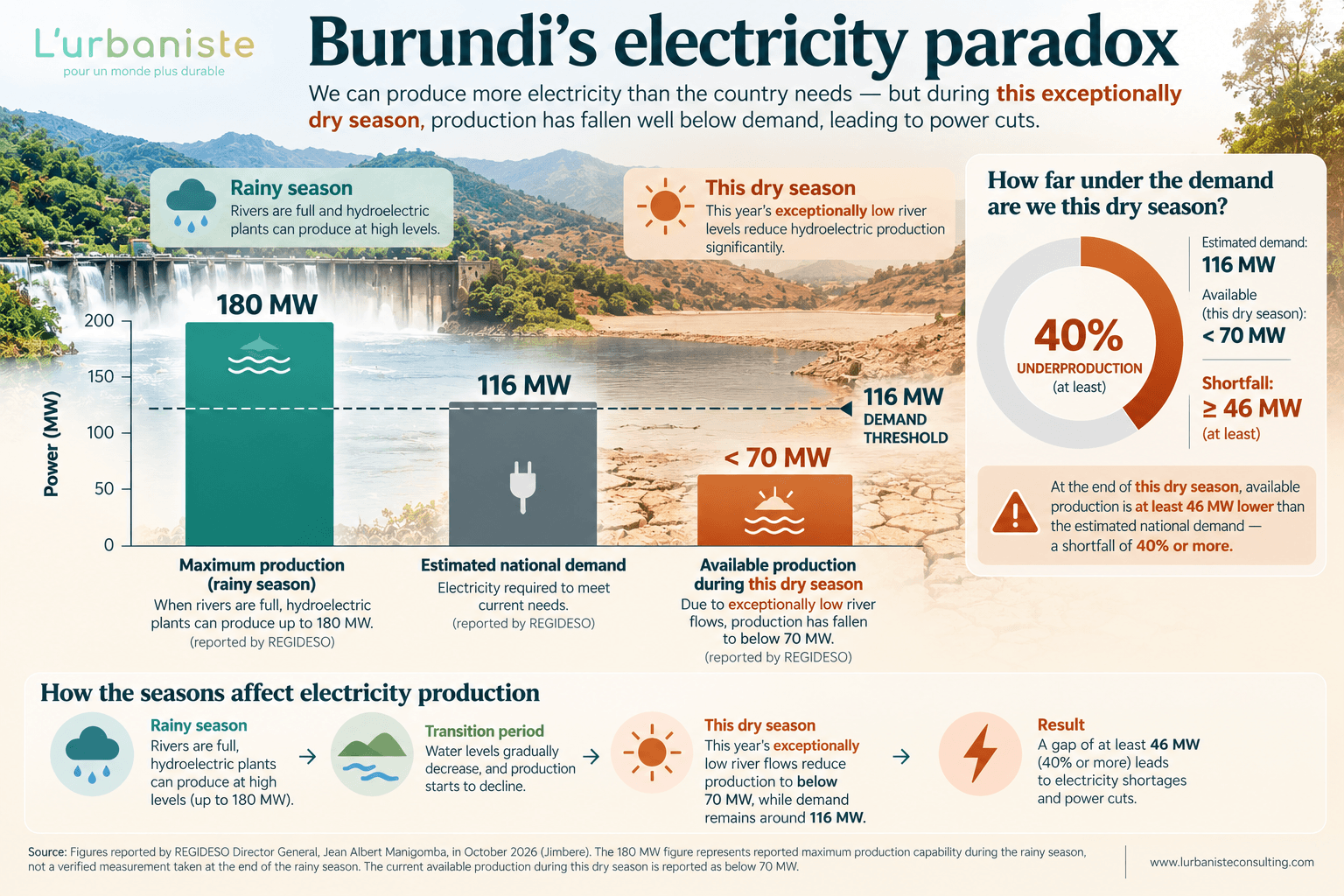
When the rivers run low, electricity production follows
Hydroelectricity has played a central role in Burundi's electricity system, and for good reason. It is renewable, can provide substantial electricity without burning fossil fuels, and is an important national resource.
However, hydropower generation is fundamentally dependent on hydrology.
A hydroelectric plant's output depends on factors including the volume of water flowing through its turbines and the available hydraulic head. When river discharge declines, the amount of electricity a plant can produce may decline too—even when the turbines and other equipment remain fully operational.
This is particularly relevant in Burundi, where many hydropower facilities depend on river flows rather than large reservoirs capable of storing substantial quantities of water across seasons.
During this exceptionally dry period, reduced water availability has constrained production at several facilities, including recently developed hydroelectric installations, according to REGIDESO's public explanations. [1, 2]
This illustrates a broader challenge: a renewable energy system can still be vulnerable to climate variability if it depends too heavily on a single natural resource.
One of the impacts of climate change in Burundi are more recurrent, more prolonged and more intense droughts during the dry season. In combination with changing rainfall patterns, catchment conditions, land-use changes and water management this is intensifying the reduction of river flows.
Electricity systems need to be designed to withstand variations in these conditions—not simply perform well when rainfall is sufficient.
More infrastructure is necessary. But is it sufficient?
Burundi has made significant progress in developing electricity infrastructure.
At the inauguration of the Jiji hydroelectric plant in June 2025, the Presidency reported that the country's electricity production capacity had increased from 47.35 MW in 2020 to 166.29 MW in 2025. The Jiji project alone was reported to contribute an additional 32.5 MW. [3]
These are important achievements. They reflect years of investment and collaboration between the Government of Burundi and its development partners.
At the same time, the country faces a second major challenge: ensuring that generated electricity can actually reach consumers reliably.
Much of Bujumbura's distribution infrastructure requires rehabilitation and modernization. The ongoing ASCENT Burundi programme includes strengthening the national 30 kV network, upgrading existing lines and modernizing the electricity distribution system in Bujumbura and its surrounding neighborhoods. REGIDESO announced a contract for the national network component in June 2026. [4]
These investments are essential. An outdated network can cause technical losses, outages, congestion and service interruptions even when sufficient power is available.
But two different problems require two different solutions.
Network rehabilitation improves the ability to transport and distribute electricity.
Generation diversification improves the ability to produce electricity reliably under different environmental conditions.
One cannot fully substitute for the other.
A modern distribution network cannot deliver electricity that hydropower plants are unable to generate because river flows are too low.
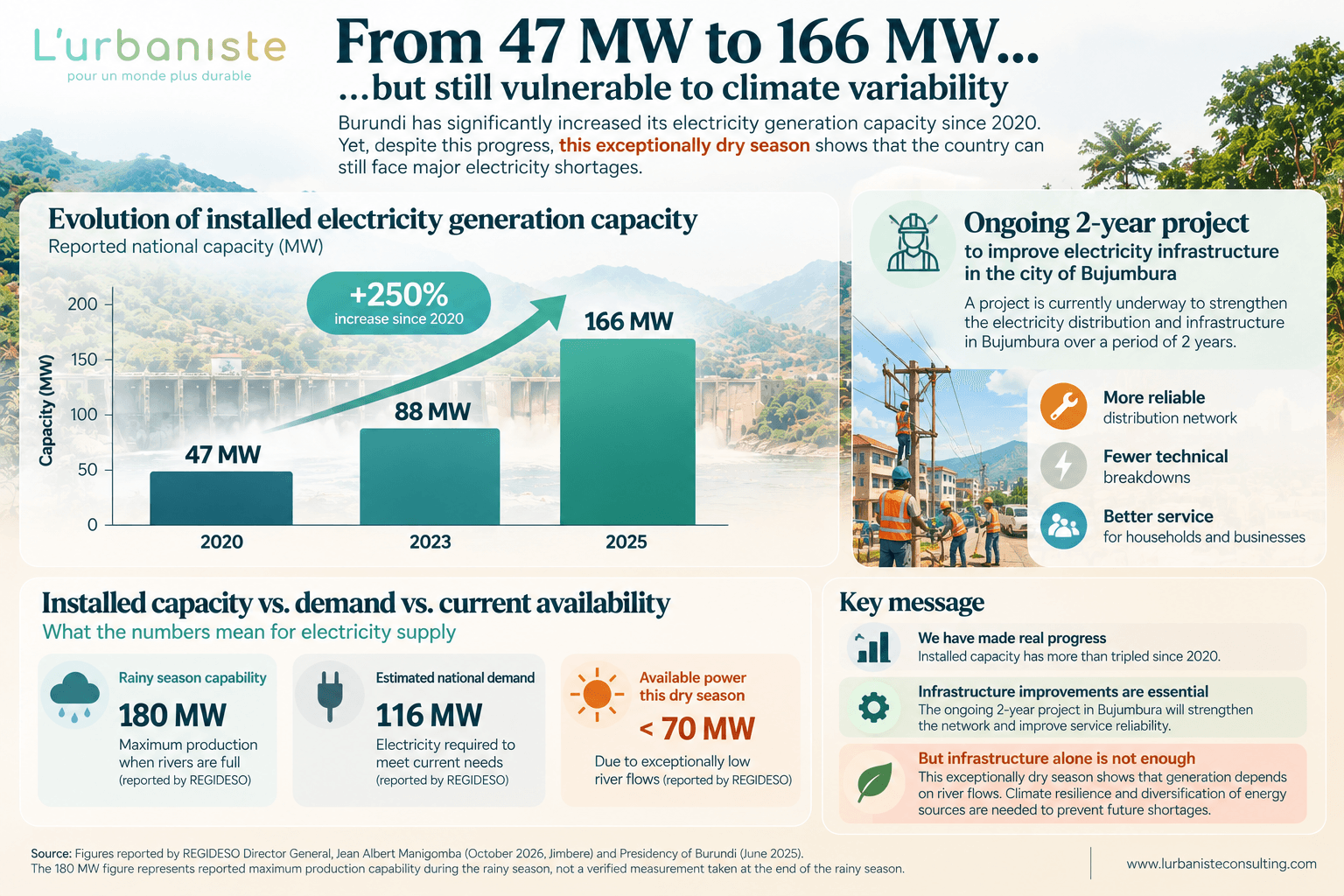
The missing piece: diversifying Burundi’s renewable energy mix
The current situation should encourage a different way of thinking about electricity investment.
Instead of asking only, How much electricity can Burundi produce when all its hydroelectric plants are operating at favorable capacity?, we should also ask:
How much electricity can Burundi reliably produce during its most difficult months?
This question changes the investment priorities.
It is not an argument against hydropower. Burundi should continue to benefit from its hydroelectric resources.
It is an argument for complementarity.
A resilient electricity system combines energy sources whose availability and operational characteristics differ, so that a shortage in one source does not automatically translate into a nationwide electricity crisis.
For Burundi, three areas deserve particular attention.
1. Make solar energy a central pillar of diversification
Burundi has a resource that remains available even when its rivers run low: sunlight.
The World Bank has identified solar photovoltaic energy as a promising option for Burundi, both through large-scale generation and through off-grid systems and mini-grids. Its climate and development analysis also notes the country's first utility-scale solar installation, commissioned in 2021. [5]
Research on western Burundi estimates average solar irradiation of approximately 5.3 kWh/m² per day, with relatively limited seasonal variation, supporting the potential for year-round photovoltaic generation. [6]
Solar energy offers an important advantage: it can be deployed at very different scales.
Large solar farms can contribute to the national grid. Rooftop systems can supply businesses, schools, health facilities and households. Community solar installations and mini-grids can serve areas where extending the central grid is costly or slow.
This decentralized dimension is particularly important.
Electricity resilience should not depend exclusively on the capacity of one national network. Well-designed decentralized systems can reduce dependence on centralized supply, provide local backup and expand access to communities that remain underserved.
The sun is sometimes discussed as part of the problem during the dry season, because high temperatures and evaporation can contribute to water losses. But the same sunlight can also be part of the solution.
Rather than relying almost exclusively on the rivers, Burundi can make much greater use of its solar resources.
Solar power will not solve every problem on its own. Photovoltaic output varies through the day and is unavailable at night. This is why solar deployment must be accompanied by appropriate storage, grid integration and system planning.
2. Invest in energy storage and decentralized resilience
Electricity generation and electricity availability are not the same thing.
Solar panels produce electricity when sunlight is available. Households, hospitals, businesses and communities also need electricity in the evening, overnight and during unexpected outages.
Energy storage helps bridge that gap.
Battery systems can store electricity generated during the day for use later. They can also support backup supply, improve the integration of variable renewable generation and reduce the impact of short interruptions, depending on their design.
Like solar panels, batteries can be installed at different scales.
For an individual household, a solar-and-battery system may provide essential lighting, communications and refrigeration. For a business, it may reduce operational disruptions. For a health facility, it may support critical services. For a community, a solar mini-grid with storage can provide a more dependable local supply.
At larger scales, storage and flexible grid operations can help balance electricity generation and demand.
Storage is not a substitute for sufficient electricity generation, and batteries require careful economic, technical and environmental assessment. But they can make solar energy significantly more useful and help communities manage disruptions.
The strategic opportunity is therefore not simply to install more solar panels. It is to develop integrated solar-and-storage solutions suited to Burundi's institutions, businesses and communities.
3. Investigate wind-energy potential along Lake Tanganyika
Wind energy deserves attention as a potential additional source of diversification, particularly in western Burundi.
A 2024 peer-reviewed study using geographic information systems and wind-resource modelling identified western Burundi, including areas associated with Lake Tanganyika, as among the country's more promising regions for wind farm development. [7]
A separate study assessing wind conditions at Bujumbura and Muyinga examined seasonal wind patterns and their implications for electricity generation. [8]
More recent research on western Burundi found that wind resources can exhibit strong seasonality, with higher wind power density between June and October. This is particularly interesting because it overlaps with the period when reduced rainfall can constrain hydropower. [6]
However, the evidence requires caution.
The World Bank's climate and development analysis notes that average wind conditions may be more promising for small-scale applications than for large-scale wind generation. [5] The suitability of any particular location therefore cannot be established from regional studies alone.
Wind-energy development would require detailed site-specific measurements, environmental and social assessments, grid-integration studies and economic feasibility analysis.
The appropriate recommendation is not to build wind farms immediately. It is to investigate the potential seriously, particularly where wind could complement solar and hydropower during periods of water scarcity.
From short-term shortages to long-term energy security
During discussions with REGIDESO in 2025, L’Urbaniste understood that additional investment in alternative renewable-energy sources was not considered an immediate priority, in part because hydropower capacity could exceed national demand under favorable conditions.
That reasoning is understandable when electricity supply is evaluated primarily in terms of maximum available capacity.
But the experience of this dry season reveals the limitations of that approach.
An electricity system should not be assessed solely by what it can generate when conditions are ideal. It should also be assessed by how reliably it can meet demand when those conditions deteriorate.
This does not mean abandoning hydropower or neglecting the ongoing modernization of Burundi's electricity network.
It means pursuing both priorities while progressively reducing dependence on a single climate-sensitive source.
For Burundi, that could mean combining hydroelectricity with substantially greater solar generation, decentralized solar-and-battery systems, carefully evaluated wind opportunities and a stronger, more flexible electricity network.
Such diversification could improve energy security while also creating opportunities for private investment, local entrepreneurship, community electrification and more reliable public services.
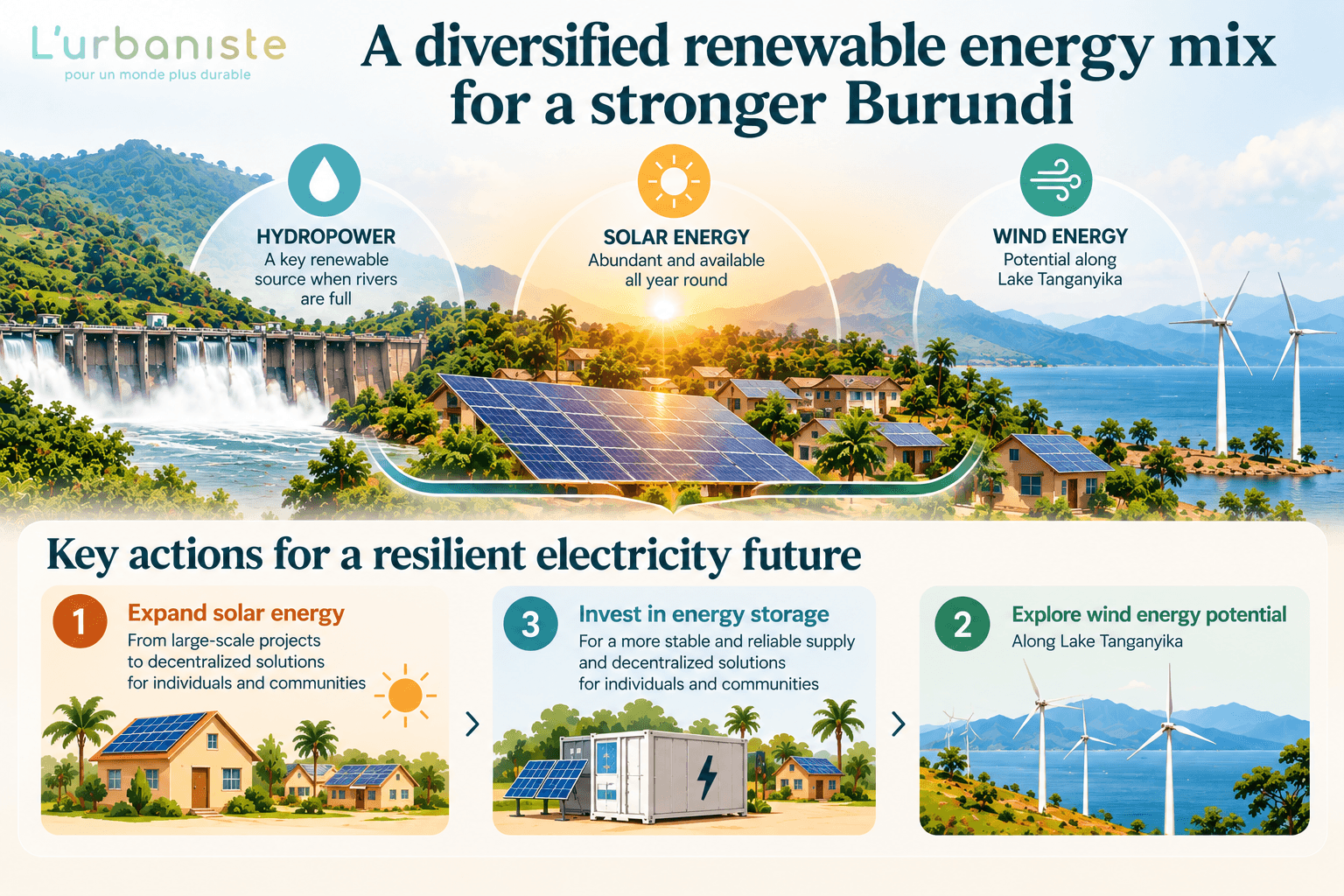
Three priorities for a more resilient electricity future: scale up solar, including decentralized community solutions; invest in energy storage; and assess wind resources along Lake Tanganyika.
Conclusion: The goal is not just more electricity. It is reliable year-round electricity.
Burundi's investments in hydropower and electricity infrastructure represent meaningful progress. The challenge now is to ensure that this progress translates into dependable electricity throughout the year.
The current shortages offer an important lesson: energy security is not measured only in installed megawatts. It is measured in the ability to meet demand reliably, including when natural conditions are unfavorable.
Burundi has water. Burundi has sun. And some locations may have useful wind resources.
The question is how to combine these resources intelligently.
We should not have to choose between water and sun.
A stronger Burundi needs an electricity system that makes them work together.
References
[1] Jimbere. (October 2026). Coupures d’électricité au Burundi : activités économiques perturbées et pertes. Reporting statements by REGIDESO Director General Jean Albert Manigomba on demand, available generation and low water levels.
[2] Le Renouveau. (October 2026). Ville de Bujumbura : les habitants se plaignent des pertes énormes subies suite aux coupures répétitives d’électricité. Includes REGIDESO's explanation of reduced hydropower production.
[3] Présidence de la République du Burundi. (25 June 2025). Inauguration par le Président Ndayishimiye de la Centrale Hydroélectrique de Jiji. Official figures on generation-capacity expansion.
[4] REGIDESO. (17 June 2026). Signature du contrat pour la mise en œuvre de la composante 1 du projet ASCENT BURUNDI : renforcement du réseau 30 kV à l’échelle nationale. Description of network modernization and Bujumbura distribution upgrades.
[5] Tall, A., Dampha, N. K., Ndayiragije, N., et al. (2022). World Bank. Tackling Climate Change, Land Degradation and Fragility: Diagnosing Drivers of Climate and Environmental Fragility in Burundi’s Colline Landscapes. Discusses solar and wind potential and climate vulnerabilities affecting infrastructure.
[6] Placide, G., Cartland, R., & Havyarimana, L. (2025). Spatiotemporal Assessment of Wind–Solar Resources for Hybrid Renewable Electrification in Western Burundi. Journal of Sustainable Development Issues, 3(2), 163–180. DOI: 10.62433/josdi.v3i2.58.
[7] Frontiers in Energy Research. (2024). Wind farm site selection using GIS-based mathematical modeling and fuzzy logic tools: a case study of Burundi. Modelling-based assessment of wind-farm suitability, identifying promising western locations.
[8] Bashahu, M., Nsabimana, P., Barakamfitiye, J., & Niyukuri, F. (2022). Assessment of the Wind Energy Potential of Two Burundian Sites. Energy and Power Engineering, 14, 181–200. DOI: 10.4236/epe.2022.145010.